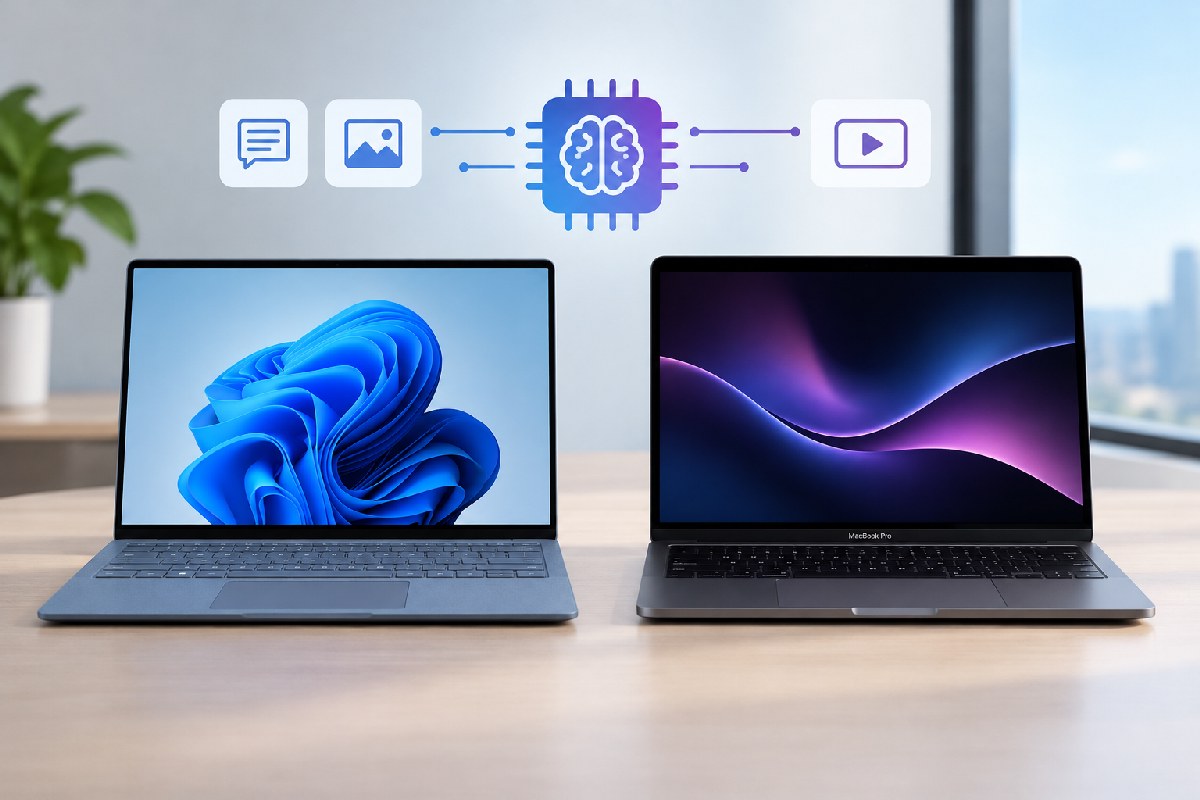
Microsoft is positioning the new Surface Laptop Ultra as a Windows alternative to Apple’s M5 Pro-powered MacBook Pro, but its performance case is focused almost entirely on local artificial intelligence workloads.
Announced at Microsoft’s Windows event on October 7, the Surface Laptop Ultra uses NVIDIA’s RTX Spark platform. The laptop is now available for pre-order from $2,599, according to Neowin. Microsoft describes it as its most powerful Surface hardware and says the design is intended for running demanding AI models directly on the device.
Microsoft’s performance claims are specific to AI
During the event, Microsoft said RTX Spark-powered Windows PCs delivered the following results against a 16-inch MacBook Pro with an M5 Pro processor and 64GB of memory:
- Up to 2.1 times faster time to first token for language models
- Up to 4.3 times faster AI image generation
- Up to 6.2 times faster AI video generation
These figures should not be read as general performance results. The testing compared selected preproduction RTX Spark systems with 64GB of memory against the 64GB MacBook Pro. Microsoft specifically identified the Surface Laptop Ultra in the time-to-first-token comparison, while the image and video results referred to a selection of RTX Spark PCs.
Microsoft has not provided a comparable head-to-head result for ordinary CPU performance, non-AI video editing, everyday applications, or battery life in the material covered here. That leaves the claims useful for buyers focused on local AI, but incomplete for anyone trying to choose an all-purpose creative or productivity laptop.
A hardware strategy built around local models
The Surface Laptop Ultra’s appeal is tied to its ability to keep AI processing on the laptop. Microsoft says configurations can offer up to 128GB of unified memory and up to a petaflop of AI compute. It also claims up to 2.5 times the thermal capacity of its existing laptops.
Those specifications suggest that Microsoft is targeting developers, creators, and other “builders” who want to run larger models locally rather than relying entirely on cloud services. More memory can also help when a model or workflow exceeds the practical limits of a typical laptop, although the evidence provided does not establish how specific applications will perform in real-world use.
Microsoft’s comparison with Apple is also part of a broader Surface strategy. The company has repeatedly used Surface hardware to demonstrate a direction it wants the wider Windows PC market to follow. Earlier comparisons centered more directly on processor performance; this launch instead makes local AI the main point of difference.
What buyers should look for next
The Surface Laptop Ultra is an interesting proposition if local AI is the primary reason for buying a high-end laptop. Microsoft’s published figures indicate a potentially substantial advantage in selected language, image, and video-generation tests.
For a broader purchasing decision, however, independent testing will matter. Buyers should wait for comparable results covering sustained performance, application compatibility, battery life, thermals, and non-AI creative workloads. Until those comparisons are available, Microsoft’s “up to” figures describe a narrow set of preproduction tests rather than a complete verdict over the M5 Pro MacBook Pro.
Read the Windows Latest report on Microsoft’s AI performance claims, and see Neowin’s report on Surface Laptop Ultra pre-orders and specifications.

Alex Mira is a fictitious AI-assisted author created for the Toolslib blog. Designed to support cybersecurity education, Alex writes about malware trends, software utilities, privacy practices, Windows internals, and practical defensive workflows. Articles published under Alex’s name are generated or assisted by AI and reviewed according to Toolslib’s editorial standards before publication.
Stay Updated with ToolsLib! 🚀
Join our community to receive the latest cybersecurity tips, software updates, and exclusive insights straight to your inbox!