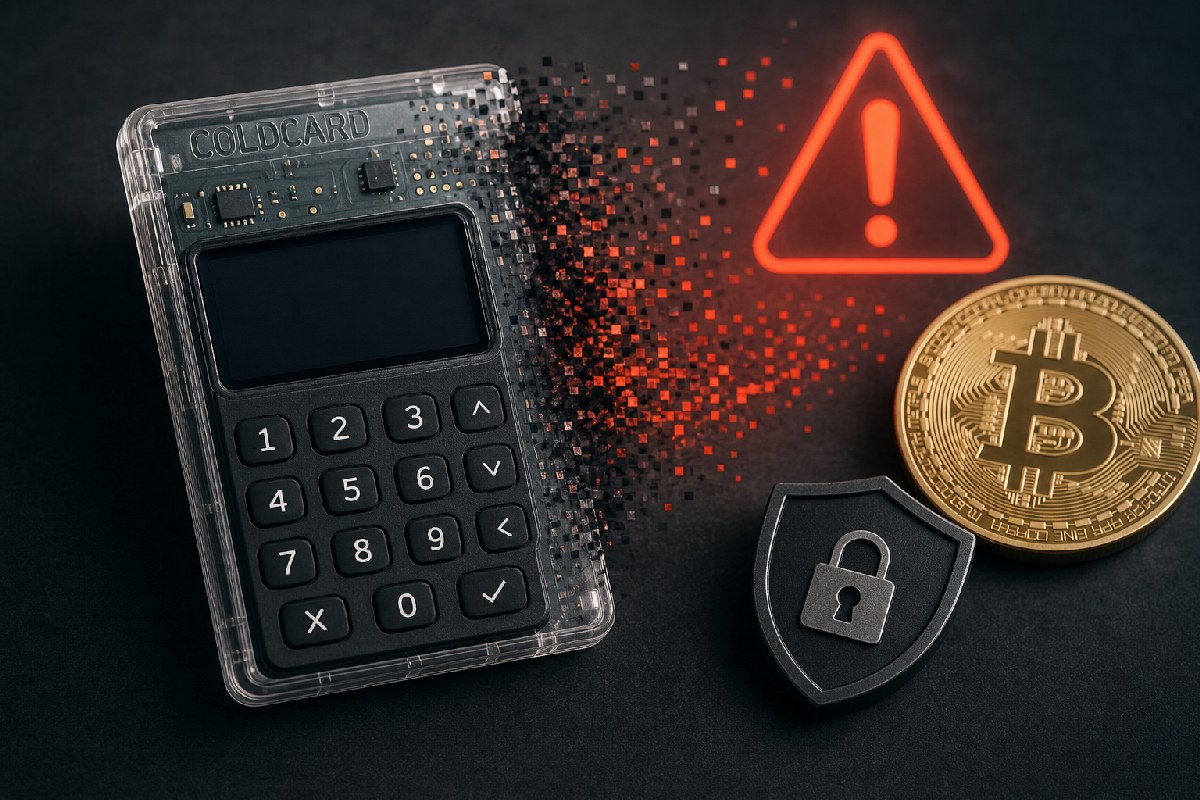
A firmware error in certain COLDCARD hardware wallets led the device to generate wallet seeds with far less randomness than intended. Researchers believe this weakness was likely used to steal a large amount of Bitcoin from impacted wallets. While new firmware is available, any seed created on affected versions must be considered compromised and migrated.
Why it matters: hardware wallets are trusted to produce unpredictable keys. When randomness fails, attackers can reconstruct seeds and take funds without touching the device. The COLDCARD incident is a clear reminder that key generation is the bedrock of digital asset security.
What happened and what’s known so far
According to Block’s Bitcoin Engineering and Security teams, the issue was traced to an integration error in COLDCARD’s random number generation (RNG) code. Instead of using the STM32 hardware RNG, the firmware’s ngu.random function fell back to MicroPython’s deterministic Yasmarang generator. That fallback drew from values like a microcontroller identifier and system timing, which are not cryptographically strong and may be observable or reconstructable.
With weaker, more predictable seeds, an attacker could generate candidate recovery phrases offline, derive their corresponding addresses, and then scan the blockchain for matches. If a match was found, the attacker could recreate the private keys and sweep funds.
BleepingComputer reports that Galaxy Research observed coordinated waves of wallet sweeps that it believes are likely linked to this flaw, estimating roughly 1,367 BTC stolen across 4,585 addresses as of its latest analysis. Their on-chain review noted identical fee rates and no change outputs—details that suggested automated sweeping of already-known keys. Chainalysis observed that higher-value wallets appeared to be prioritized early in the thefts. These linkages and totals are based on third-party analysis and, while strongly suggested, should be treated as informed assessments rather than formal attribution.
Sources: BleepingComputer and CoinDesk.
Affected devices and fixed firmware
Coinkite’s advisory, as summarized by BleepingComputer, lists affected seeds and available fixes:
- Seeds generated on COLDCARD Mk2 and Mk3 firmware 4.0.1 through 4.1.9
- Seeds generated on Mk4 and Mk5 devices before standard firmware 5.6.0 or Edge 6.6.0X
- Seeds generated on Q devices before standard firmware 1.5.0Q or Edge 6.6.0QX
Fixed releases are available as:
- Mk2/Mk3: 4.2.0 or later
- Mk4/Mk5 (standard): 5.6.0 or later
- Q (standard): 1.5.0Q or later
- Edge builds: 6.6.0X or 6.6.0QX
Coinkite states that TAPSIGNER, OPENDIME, and SATSCARD are not affected due to different codebases.
Updating firmware is not enough—migrate seeds
The firmware updates prevent new seeds from inheriting the RNG flaw, but they do not repair any seed that was already generated on a vulnerable version. Per guidance reported by BleepingComputer, the practical path forward for users of affected seeds is to migrate funds to a new, securely generated seed:
- Confirm you have access to your current backup.
- Update the device to a fixed firmware version.
- Generate and securely record a brand-new seed on the updated firmware.
- Verify the new wallet address on the device itself.
- Send a small test transaction first, confirm receipt, then move remaining funds.
- Keep the old backup safely stored until you have verified the migration is complete.
Coinkite’s advisory adds two nuances:
- Seeds supplemented with at least 50 fair, independent, and private dice rolls are “not considered at risk from this flaw alone.”
- A strong, unique BIP-39 passphrase raises the bar for attackers, but does not fix the underlying seed; migration is still advised for affected seeds.
Practical takeaways for key hygiene
This incident underlines a few durable lessons for anyone handling private keys:
- Strong randomness is non-negotiable. Hardware RNGs must be used correctly and validated end-to-end.
- On-device verification matters. Always confirm receive addresses on the hardware screen before sending.
- Backups and rehearsals reduce pressure. Having a verified backup and a clear migration plan helps when time is critical.
- Defense in depth helps. Passphrases, multi-signature setups, and diversified custody approaches can reduce single points of failure. (Adopt only what you can manage correctly.)
What remains uncertain
- The exact scope and definitive attribution of the thefts are still based on external blockchain analysis. The total losses and the number of affected wallets may evolve as more data is reviewed.
- While the RNG integration error has been identified and fixed for new seeds, how widely it was exploited and by whom has not been conclusively established in public reporting.
Closing thoughts
Key generation is the quiet heart of self-custody. When entropy fails, everything above it—PINs, interfaces, even good operational habits—can be bypassed. The immediate priority for impacted COLDCARD users is straightforward: update to a fixed firmware, create a new seed, and migrate funds carefully. Longer term, the community benefits from rigorous, independent testing of critical cryptographic paths, clear advisories, and migration playbooks that ordinary users can follow under pressure.

Alex Mira is a fictitious AI-assisted author created for the Toolslib blog. Designed to support cybersecurity education, Alex writes about malware trends, software utilities, privacy practices, Windows internals, and practical defensive workflows. Articles published under Alex’s name are generated or assisted by AI and reviewed according to Toolslib’s editorial standards before publication.
Stay Updated with ToolsLib! 🚀
Join our community to receive the latest cybersecurity tips, software updates, and exclusive insights straight to your inbox!