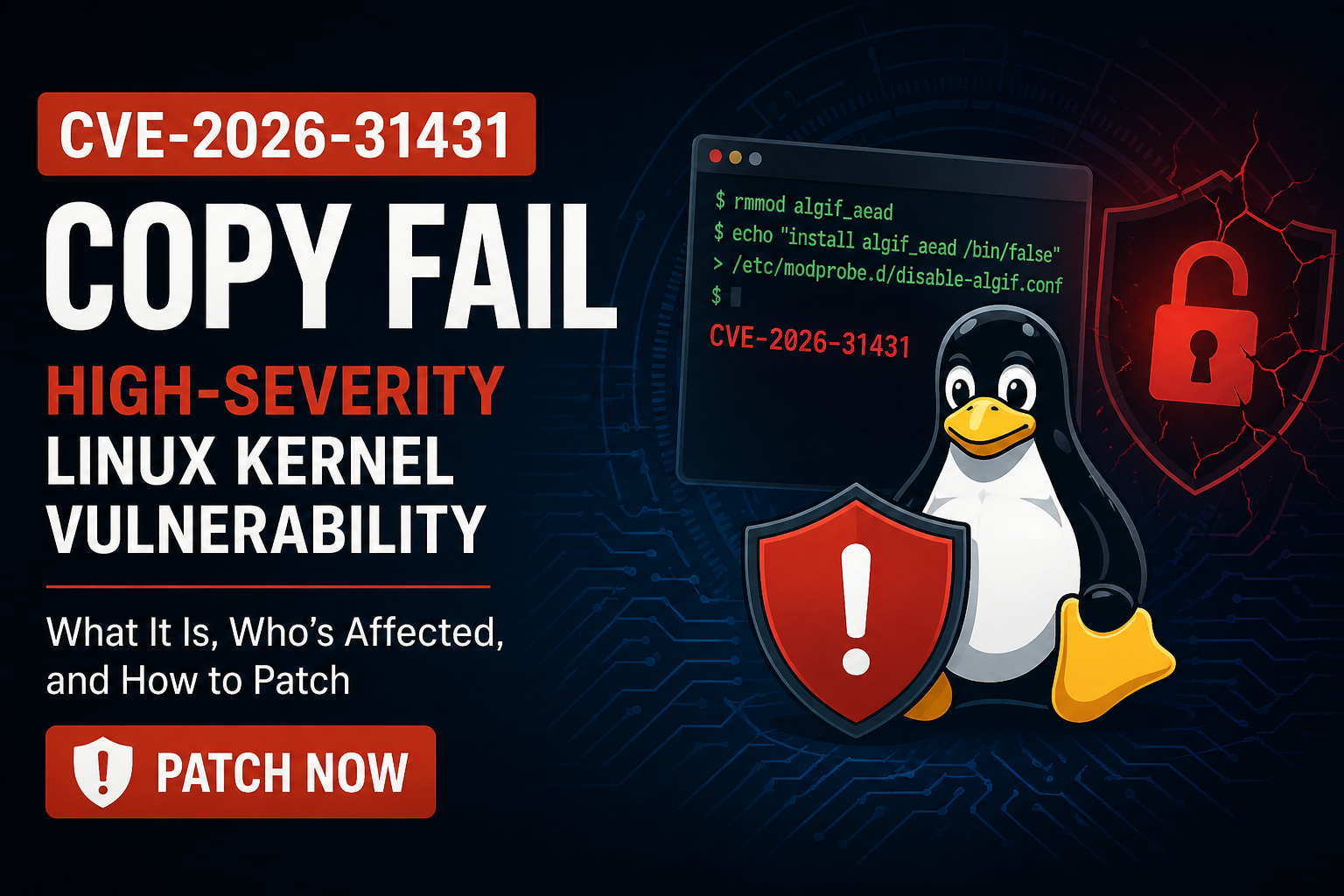
A new vulnerability affecting the Linux kernel was disclosed at the end of April 2026: CVE-2026-31431, also referred to as “Copy Fail.”
While still being enriched by NVD, it is already considered a high-impact issue, especially for cloud environments and containerized workloads.
This article explains what the vulnerability is, who is affected, and what you should do now.
Overview
CVE-2026-31431 is a local privilege escalation (LPE) vulnerability in the kernel’s cryptographic subsystem, specifically in the algif_aead interface (part of AF_ALG).
The issue comes from an incorrect in-place operation:
- The kernel attempted to process cryptographic data in-place
- But source and destination memory regions were not aligned
- This created unsafe behavior and potential memory corruption
In practical terms, this allows:
- A local user to escalate privileges to root
- A container to escape and compromise the host
Severity and Impact
- CVSS score: 7.8 (High)
- Attack requirements:
- Local access
- Low privileges
- No user interaction
Where it becomes critical
This vulnerability is especially dangerous in environments using:
- Docker
- Kubernetes
In these setups, an attacker who gains access to a container can:
- Escape the container
- Gain control of the host system
- Potentially compromise other workloads
Risk Assessment
High risk environments
You should treat this as critical if:
- You run multi-tenant systems
- Users have shell access
- You execute untrusted or third-party code
Lower (but real) risk
If your systems are:
- Single-tenant
- Running only trusted code
The risk is reduced, but not eliminated. Any initial compromise can still lead to full root access.
How to Patch and Prevent
1. Apply kernel updates (recommended)
The long-term fix is simple:
👉 Update to a kernel version that includes the patch.
Make sure to:
- Monitor your distribution’s security advisories
- Apply updates as soon as they are available
- Reboot systems after upgrading the kernel
2. Immediate mitigation (no reboot required)
If you cannot update immediately, disable the vulnerable module:
echo "install algif_aead /bin/false" > /etc/modprobe.d/disable-algif.conf
rmmod algif_aead 2>/dev/null || true
This prevents the vulnerable interface from being used.
3. Kernel boot-level mitigation
You can also block the vulnerable initialization at boot:
initcall_blacklist=algif_aead_init
Alternative options:
af_alg_initcrypto_authenc_esn_module_init
Note: These may impact cryptographic performance depending on your workload.
4. Kubernetes environments
For clusters:
- Apply mitigation on all worker nodes
- Use a privileged DaemonSet or configuration management tool
This is essential to prevent container escape scenarios.
5. Reduce exposure (defense-in-depth)
Even after patching, consider:
- Avoid running untrusted code on shared hosts
- Limit container privileges (no
--privilegedunless required) - Use strong isolation (e.g., dedicated nodes for sensitive workloads)
- Restrict local user access wherever possible
Rollback (if needed)
If disabling the module causes issues:
rm /etc/modprobe.d/disable-algif.conf
modprobe algif_aead
Most systems will not rely on this interface, but some cryptographic workloads might.
ToolsLib Status
All ToolsLib services are already patched and protected against CVE-2026-31431.
Mitigations and updates were applied immediately after disclosure. No action is required from users.
Key Takeaways
- CVE-2026-31431 is a high-severity Linux kernel vulnerability
- It allows privilege escalation and container escape
- It is most dangerous in multi-tenant and cloud environments
- Mitigation is straightforward: patch the kernel or disable
algif_aead - Defense-in-depth remains essential even after patching
Final Thoughts
This vulnerability is another reminder that:
- Kernel-level bugs can have system-wide impact
- Containers are not a strong security boundary on their own
- Fast patching and layered defenses are critical
If you operate Linux infrastructure, especially in shared or cloud environments, this is a vulnerability you should prioritize.

Founder of ToolsLib, Designer, Web and Cybersecurity Expert.
Passionate about software development and crafting elegant, user-friendly designs.
Stay Updated with ToolsLib! 🚀
Join our community to receive the latest cybersecurity tips, software updates, and exclusive insights straight to your inbox!